I am looking for work. In the immediate future that’s probably a freelance contract. But I’m also using this time to hold conversations with people to figure out what’s up and where I might fit. I am welcoming inspiration to help me determine what might be next.
What I’m trying to do with this post
This post aims to bring all the skills I’ve developed in and out of design studios, local authorities and the built environment and package them in a way that helps me to explore what I could do next. I hope to secure some work in this way. But I also want to use the time I have to think more strategically about my career.
This post is a total rip off of Dr. Laura James’s blog which helped her land a solid job. Finding myself in a similar position (I too don’t necessarily have the job I want next in mind), I thought I would do the same. Laura, thank you for sharing your process.
I’m Lucy
I am a lead design researcher, community organiser and urban food grower. I work collaboratively to identify, define, build and test ideas that confront the climate crisis and enable a just transition.
I use the word ‘design’ to describe my work in its broadest sense. I build shared understandings of different things and encourage feedback and testing to inform their development with people who’ll actually use them in the environments they use them in.
To do this, I pull from service design tools and processes as well as systems change and participatory practices. The things I help to build include digital products and services. They also include stewardship models and governance structures. I have led research projects that have informed the design of policy, funding calls and physical spaces.
Important to highlight and celebrate are my leadership skills. I can be a critical friend but also hold a project budget. I can facilitate learning for individuals but also command direction and plan ways forward. I can support multidisciplinary teams to make sense of complexity and identify what’s needed. I work best with visual designers and thrive working in environments with scientists, artists academics and policy people. I’m fun to work with, playful but serious. Creative but outcomes focused.
The varied contexts and experiences in which I’ve worked have contributed to my adept navigation of complexity and my approach to working with different people. I hold an increasing grasp of climate mitigation, adaptation and resilience measures and I would like to continue to confront these questions in my work and bring diverse perspectives together to collaborate.
In my last role at Arup, I worked as part of a talented team of designers to apply human centred design to the built environment. The job presented great opportunities to work with landscape architects, engineers, planners and utility suppliers to think critically about our cities and neighbourhoods, about our critical infrastructure and our sense of place, now and well into the future together with the people that are part of them. I’d love to continue on this path and take a relational approach to research and design that considers how we reduce our impact on the environment, and provide more maintenance and care in reviving ecosystems in ways that don’t entrench change in capitalist systems and methods of extraction.
Basically, I want to work with good people on useful things. It would be nice to build stuff and not just write reports.
Some ideas about what I could offer
- Support to bring a new sustainable product or service to life by addressing barriers to adoption
- Crafting climate related strategies, adaptation plans and even emergency response services together with staff, residents and local people
- Help to identify and design how to build places that are climate resilient
- Reduce barriers to eco-ableism
- Support to build equitable transport systems through research and design
- Opportunities to apply the tools and skills we’ve developed in our sustainable services design course to a ‘traditional’ service design brief
I’m looking for paid work, mostly remote but I can commute to London when needed. And I work 4 days a week because I’m building my horticultural skills on the side.
Maybe you’ve got a problem that needs support to solve, or you need to figure out how to do something new. I’m up for wide chats, new friends and definitely new perspectives. Introductions to others are most welcome.
Email me:
hello@lucyworks.co.uk
___
Read on to find out more about what I can do through descriptions of four pieces of work that I have helped to deliver across the domains in which I work.
___
Research and design
I lead mixed method research projects working with health professionals, infrastructure asset managers, fishermen, and community groups to inform the design of new products and and services. I can plan research projects, conduct in-context and remote interviews and synthesise research into findings you can do something with – that turn into tangible and outcomes, not just summary reports. I work best on multidisciplinary teams with visual designers to bring research findings to life.
1. Grow Green with NatWest
As a research lead, I led a multidisciplinary design team to work collaboratively to identify, define, build and test ‘Grow Green’, Natwest’s early prototype of what’s now their ‘Energy help and support’ service. The service helps SME’s to understand their energy usage and find ways to save. NatWest would then stipulate the conditions of a loan to enable companies to purchase technologies like solar panels and reduce costs to their business and carbon emissions.
I led a mixed methods research including interviews, design and integration workshops with partners, user testing, business case development and communications.

service.
It was fantastic to contribute to something that is now live and widely used. It demonstrates the power of integration and partnership and how these combined offers so necessary in order to provide companies with tailored solutions.
Participation and facilitation
I can design and facilitate opportunities that bring different groups together to enable collective decision making and co-design. I love a gathering, and have a big belief in public participation and in the power of deliberative conversation and dialogue which I grew as a Participation Lead at Adur & Worthing Councils. I have designed and led public statutory consultations as well as participatory workshops. My work considers the necessary changes within organisations to develop new forms of governance and increase community power.
2. Building a shared management plan for land restoration
In 2020, Adur & Worthing Council ended a farmer tenancy on Cissbury fields, opening up an opportunity for nature restoration. Cissbury fields is popular with residents and dog walkers. It is also incredibly important for biodiversity since 80% of chalk grassland habitat has been lost in the UK. Our objective was to work in a participatory way to co-evolve a management plan with a diverse group of stakeholders.
I conducted desk research including a historical analysis, current and future ecological data and climate projections. I curated this information together to inform a series of co-design workshops to build historical and future projections and shared goals. I led a series of conversations which brought together ecological data, historical artefacts, recent human memory to explore land use change and ecosystem evolutions stretching back into deep time. We then seeded multi-stakeholder conversations with practical learning from other sites on dog fouling and chalk grassland conservation in combination with climate projections.
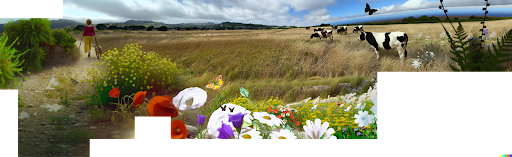
These conversations have resulted in the co-design of a management plan to use conservation grazing with cows to echo the way our ancestors looked after the land with their animals. It is too early to speak of biodiversity gains but I heard the orchard is now on place on site which will provide a space for the community to gather, plan and store tools that they may need to help manage the site.
Capability and community building
3. Designing Sustainable Services masterclass
Designing Sustainable Services is a one day course offered by The School of Good Services that provides tools and key questions to embed sustainability within service design processes and help influence wider organisational change. I designed the content together with Ness Wright. The course consolidates 10 years of shared experience in this area.
Designed across 7 modules, the masterclass examines how the design and delivery of services contributes to the climate crisis. The course supports participants to to identify where the key opportunities are to design sustainable services and presents ideas as to how to adapt design tools and processes to make sustainable design decisions. Participants learn how to measure, monitor and learn from sustainable service adjustments, how to identify risk and build service resilience and how to make the business case for sustainable service design.
In 2024, we delivered the course to over 30 participants and three further courses are on offer through 2025.
Long-time thinking and strategy
I’ve always hesitated to call myself a strategist (I have a problem with it) but my work informs strategy by being outcome focused and de-risking decision making. By bringing climate considerations into any brief, I can help teams and decision makers frame questions over the long-time and adapt strategies to develop more climate conscious organisations. This helps to build organisational awareness and collective resilience.
4. Facilitating water stewardship with Arup and Enabling Water Smart Communities
Enabling Water Smart Communities (EWSC) is an Ofwat funded innovation project exploring the relationship between integrated water management, community engagement and practices and housing development to unlock new opportunities for cross-sector delivery and stewardship.
This year, I’ve been working closely in partnership with United Utilities, the Community Land Trust Network and the Centre for Local Economies (CLES) as a research lead to inform the development of water stewardship models for new housing developments. We dissected land trust case studies to develop stewardship components and conducted user research with residents of housing developments with water assets to understand roles, responsibilities and values. We’re building a systemic picture of what needs to change in housing and water sectors to enable water stewardship and mitigate the impact of flooding and drought.
This enabling actions project is complex and ongoing. We’re developing a blueprint for water stewardship and hoping we can expand on its utility in place and partnership with a progressive developer, local authority and community land trust.
____
My portfolio can be found on the ‘What I do’ page and here is my LinkedIn
Thank you for reading.
This post is brought to you by Bug Beds Ltd

 Lucy Stewart
Leave a comment