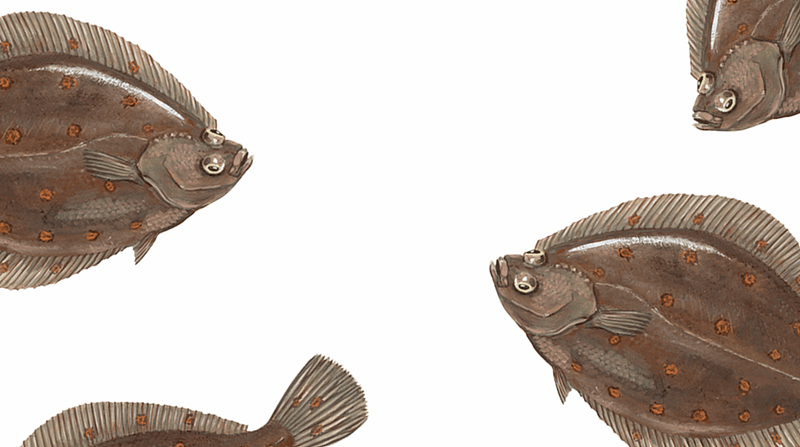
In Lauren Silverman’s beautiful piece on love and trout, she states — “all of us are fish”. Like the plaice that inhabits the waters off of the Sussex Coast, as we develop, our eyes start far out on the sides of our heads and move inwards as we grow in the womb — we look like guppies until we get zipped up. As well as sharing early morphologies to fish, we inherit similar patterns of behaviour. Social creatures, fish behave by attraction. Acting in groups, they “select shoal mates on the basis of their colour patterns”. We find our communities and stick with them for safety and to interact with others in a wild web of survival.
We are all fish.
I wrote this while the Sussex sea was raging. All beaches along the south coast were closed as effluent poured in and outwards, like a dirty arm outstretched carrying human filth to the mouths of our aquatic brethren. All I can think about is the fish. If I can’t swim, can they?
Inshore fisheries and the habitats they depend on are most vulnerable to the impacts of wastewater pollution. It seems we forgot to factor in this hugely significant blight on the Sussex seas into our exploration of how to build and sustain a market for inshore small boat fisheries which we believe are necessary to celebrate and protect small scale heritage industries and the oceans that sustain them. But the blight highlights the interdependencies and intricacies of working at the intersection of non-humans and the habitats we share with them as people, brings a more urgent recognition to the importance of initiatives like Sussex Bay and the complexities of shaping such initiatives with intent.
Sussex Bay
Sussex Bay is a generational ambition and an extensive growing partnership working to restore the seas, coasts and rivers from Rye down to Selsey in efforts to urgently and consciously tackle the crises Sussex (and the world) faces — the serious and growing local impacts of climate change, and the catastrophic biodiversity loss in Sussex rivers and seas. The vision currently holds a number of different initiatives at multiple intersections of ecology and social science, from the Sussex Kelp Restoration Project to Weald to Waves which links the effect of sediment analysis with farmers upstream to the impact this has on coastal habitats.
The partnership links are massive and brave which is a huge testament to Paul Brewer who has kept the fins moving as the shoal grows with attraction of partners on land and at sea. I feel so fortunate to play a small part in it at such an early stage in its unfurling.
With funding from the Marine Management Organisation and a lovely partnership that has turned into a friendship with Di Alcrofft at WayFroward, I swam my way back into the fishing industry after early career foray and have been fortunate to find myself working with others in efforts to figure out how to create and sustain new industries for small boat fishing so it works better for fishers, fish and our inshore marine habitats.
Sussex Bay Fish
The Sussex Association of Inshore Fisheries and Conservation Authorities (IFCA) instituted a bylaw in March 2021 that prohibits fishing with towed gear between Selsey and Shoreham and 4km out to sea. Already there are early indications that the fish are coming back. Off of this surge, we were tasked with a formidable brief- to assess the viability of a Sussex Bay Fish brand to support a healthy marine environment, the long-term survival of Sussex’s small boat fishers, and determine a model for the brands self finance.
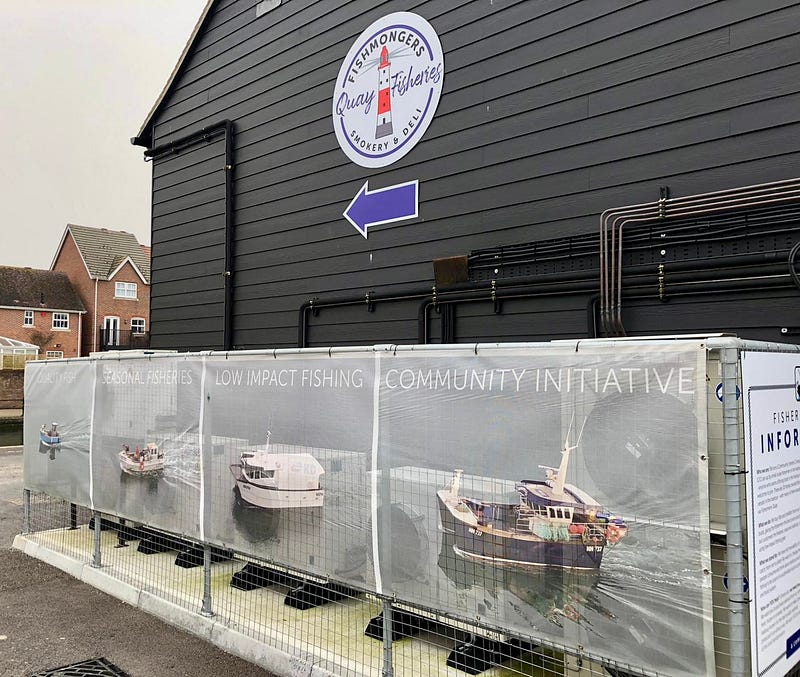
In the net of Sussex Bay projects, our thread aimed to understand what ‘local and responsibly caught’ meant as well as establish demand and supply for what we believed a brand could represent. Our research enabled us to craft a pitch for a brand and test it.
Sussex Bay Fish puts a face to the collective efforts to restore local coastal ecosystems by celebrating the practices and the people that are on board with what’s good for under the sea. The brand aims to promote the benefits of small boat, lower impact fishing, and local, seasonal fish to replenish local communities and restore coastal habitats.
The aspiration was to gear up for a launch but we quickly established a reality that was quite different as there is no shared definition of what ‘local and responsibly caught’ means based on the perspectives of consumers, retail establishments, fish wholesalers, part time and full time fishers, regulatory bodies and conservation charities and NGOs — all of whom we spoke to.
The complexity of perspectives, the reality of rustling an industry already so at sea and the confidence necessary to handle, merge and curate data in a viable balance humbled me. Positioning a brand between a shared definition that excludes trawled and dredged seafood would meet environmental aims but exclude many Sussex fishers who are already battered and bruised and facing unfathomable challenges. This also ignores the history of fishing in Sussex and the hyper local jobs it sustains which cannot simply be abandoned. We met fishers whose familial relationships with the sea and to fish extended back some 300 years. They know it like family and treat it as such. This immense relational knowledge reflects so much of my work in participation being about advocating for usually unrecognised forms of knowledge to be centred in decision making.
Where we’ve landed
Crafting a brand designed to balance the environmental goals of Sussex Bay with the economic needs of local communities will be a significant challenge. The tradeoffs between protecting marine ecosystems and prioritising the economic needs of fishing communities have not been fully addressed. Given the need to stimulate demand as well as concerns regarding supply, we concluded that a launch of a brand is not viable- at least not now.
Instead, we proposed a series of low cost, local pilots as a next step to test hypotheses and create momentum and build better networks where there are already ‘pockets of energy’ e.g. supportive fishers, existing infrastructure or engaged consumers.
These include a suite of communication tools, a direct to consumer sales channel to enable small boat fishers to sell their catch direct to consumers, pop-up retail propositions and a delivery mechanism. Across all of these is a need for the promotion of local, seasonal species. I can’t wait to munch a Dab baguette.
As well as building the business case, our suggested experiments could help to inform the evolution of the brand and how to balance its three aims. Combined they would curate continued outreach which is necessary to build trust and develop relationships with those in the Sussex supply chain.Where we left highlights the gap in investment needed in movement making. When so many perspectives need to combine on an idea, it needs more time and nurturing by simply bringing people together than most funds enable.
Reflections
This project and subsequent movement we’re trying to build has landed my work at the intersection of law, governance, ecosystems and communities and laid bare the complexities of habitat restoration where there’s never a straight or single answer. It’s also challenging me to think creatively about financial mechanisms that are necessary to curate a restorative balance. I’d be curious to explore trials of universal basic income applied to communities with vital relationships to ecosystems. As a fisher in Bognor suggested, they need five years away from Bognor Rocks. If incentives were facilitated to do so, what would that look like and what would the ecosystems look like as a result?
We’re committed to keeping this work going in partnership as the idea of Sussex Bay evolves. As more attention gets paid to effluent runoff and to the state of our seas we hope we can continue to capture imaginations of what’s below and bring us closer to our fish and to ourselves.
If you have ideas for continued funding, or want to share learnings for similar projects please get in touch.
I’d like to shout out again to Di, and to Sarah Hunt for the researching and the writing. And to Caroline Bennett at Sole of Discretion, Sam at Blue Marine Foundation and Jack at Catchbox for unwavering support and guidance and to Paul for connecting me to the project and to Sussex Bay in the first place.
 Lucy Stewart
Leave a comment