Working to restore chalk grasslands in West Sussex.
Big thanks to Councillor Vicki Wells and James Sainsbury at Worthing Museum for the deep history associated with the site and for sharing your knowledge and to Graeme our resident park ranger for your love of the land. And to Jody and her son Jonah for leading the way.
In his writing on ‘Accelerated and Decelerated landscapes’, Brett Milligan talks of time-altered terrains — the stop and start of changes over time put in place to balance human need with nature’s flow. It’s through this piece that I discovered Professor Barbara Adam, and her concept of ‘timescapes’- the practice of “tracing how human practices of time intersect and affect social and nonhuman rhythms.”
Some of my most enriching work is now centred on timescapes. Aided by the thoughtful, experienced and patient practice of Jody Aked, we’re applying this theory to imagine shared futures of Cissbury Field, a beautiful site in West Sussex recently repurchased by Adur & Worthing Councils in efforts to regenerate the landscape and bring the skylarks back. But through this work we’re exploring the art of regenerating people and connecting what was to what is and what will be together in balance.
What was
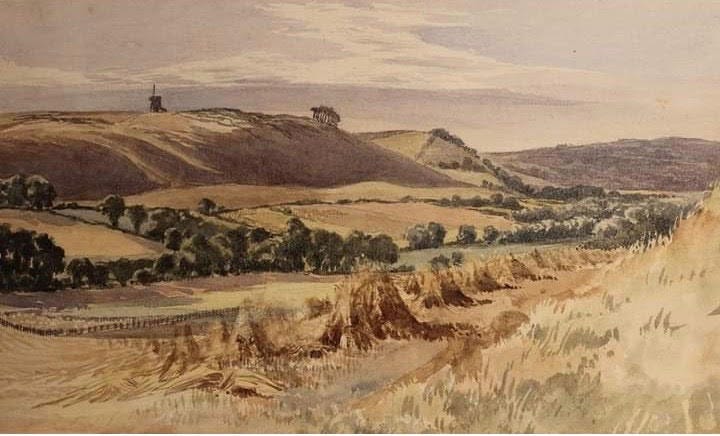
Many conversations on regeneration converge on metaphors about soil. But I want to talk about chalk (Creta) and about flint. Chalk is the decay of trillions of microscopic, calcium shelled organisms called coccoliths and foraminifera that when organised into a new structure form the soft white dimensions of limestone. This all happened during the Late Cretaceous, 100 million years ago in a vast ocean called the Tethys — named after the Greek goddess of the sea.
Flint is a quartz rock formed from the decay of elaborate skeletons of tiny organisms called radiolarians as well as the remains of sea sponges that decayed into a slick snot that blanketed the seafloor. Like a runny nose it seeped into the burrows made by crabs and lobsters and covered all the dead sea creatures that faded into the depths of the seabed. Over time, the snotty substance recrystallized into vast sheets of extremely hard rock now known as flint.
Over time flint and chalk intertwined and ungelated in a dance across their own timescapes. Their rhythm curated the formation landscapes that would shape and sculpt the survival of Homo heidelbergensis, neanderthals and early modern humans who chose to move around less fluidly and freely, instead they choose to “settle” and call Sussex home in the Stone Age.
As humans evolved in place, so too did a complex ecology. Today, the chalk grasslands of Sussex and of Cissbury specifically are so intricately diverse that they have been dubbed the European equivalent of the tropical rainforest (Sussex Wildlife Trust). Soil is thin in these parts, and chalk so porous, that the rain drains through and takes the nutrients with it. Centuries of grazing on site has kept species in check with one another by curtailing competitiveness enabling so many species to thrive in a terrain that would normally be inhospitable.
We stand on a site of one of the earliest reminders of our shared connection to place, and the necessary shared use of space with others. It’s here where timescapes begin and where our interest in how human practices have affected nonhuman rhythms. If death has always shaped life then people have always used Cissbury. We know the fields will always need to balance human use and nature’s needs.
British history was as much in relation to the land as any, and in this work we’re exploring ways to bring it back. As a facilitator it feels like choreographing a dance to mimic the intertwinedness of flint and chalk that worked together to create new structures that moved us, temporarily into a new space. As with much of my work, it becomes a question of how.
What is
Barbara Adam describes ‘unfolding events’ as temporalities. Using this frame, our work focuses on unearthing unfolding events together with the community including Findon Valley Residents Association, Worthing Museums and the South Downs National Park as well as the knowledge and connection of local Councillors. We’re coming together to explore what collective future use of the fields might look like and how it can best serve the people that use it and species that inhabit the land.
Our early intent was to harness the wisdom of residents and the people that know, use and love the fields to collectively map changes to the site over time and relate human patterns of behaviour to the experiences of other species including the addar, skylark, pyramidal orchid and butterfly species like the chalk hill blue. Our reflections expanded to the use of grazing animals and cattle who through long history have been so vital to shaping the sites ecology.
Together we have been reflected on temporalities in relation to place. We’ve plotted responses on a timeline with unfolding events collected all way back to the 1940s through to the present day. We can see how the use of the field has changed and what effect it’s had on co-habitants.
- 1940s: during the second world war, the fields were used as preparation and training areas for Canadian troops ahead of D Day.
- 1960s: wheat grew on the fields and they started to be used for agriculture including cattle and sheep grazing. Informal recreational use of the site began.
- 1980s: the long meadow had surface water problems in heavy rain and overflowed to flood houses and gardens. Between 1980–1981, farmers changed ploughing practice from down the field to across the field. This stopped water from overflowing. The field was cut for hay.
- 1990s: Last cows believed to be seen 25 years ago
- Early 2010s: onset of ash dieback
- Late 2010s to present: Over the last 3–4 years, commercial dog walkers have appeared
- Now: Residents have observed that the fields have not been cut. Recently, when it rains there are puddles at high-footfall points and more paths have been created
The temporalities we’re most interested in are those when nature and people thrived. We’ve noticed that when the public footpaths were well marked and the fields were used agriculturally things were more in balance. The dog walkers spread out. But the paths have not been managed for years and cattle no longer graze on the fields — which is why the centre of the fields can be walked through and informal paths criss-cross affecting species like skylarks who like to nest in the middle.
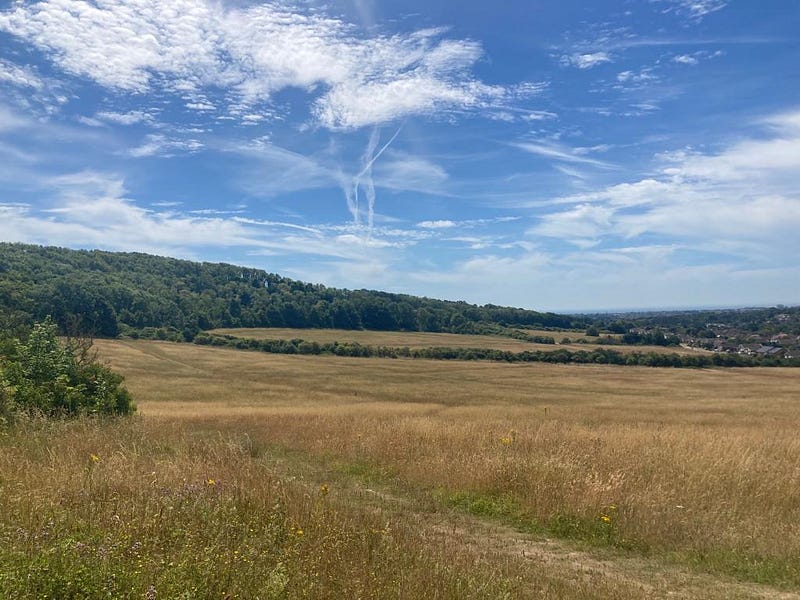
To compound these changes is the noted proliferation in the relationship between people and their dogs. We’re now in the timescape of poo. If restoration is about keeping things in balance, then cattle remain crucial to maintaining competitiveness of species. But the dog poo issue has become so severe on site, that no farmer will risk grazing as the risk of parasitic infection from Neospora canium (found in dog excrement) is too high.
But where there is imbalance there is hope. We know and share the appreciation that once people understood certain things — like the loss of skylarks or the relationship between dog waste and sickness in cattle — they are more attentive. A lot of people will respect it if they understand. There’s a real love and appreciation for this site and that’s always where we start and come back to.
Reducing this work to a design brief feels pointless. Instead I feel we’re co-developing a new era in its time-altered terrain. As Milligan writes, this demands new skills and in my opinion, new forms of patience. Our goal is to co-design and develop a management plan which will hold collective responsibility for restoring and use of the site. This will inform the development of a tapestry of financial mechanisms necessary to help maintain it. We’re learning from and connecting to Wilding Waterhall, Weald to Waves, Changing Chalk the wider Sussex Restoration Collective. There are so many good things happening in Sussex!
For now we’re continuing our appreciative research on a landscape scale together with dog owners and commercial dog walkers, residents, together with Graeme and many others. We’re toying with the idea of using GPS trackers to monitor trail usage and prototype the design dog corridors and play with temporary infrastructure designed to keep things in balance. To do this well we need to understand overspill and where else dogs can go and recognise that many dog walkers are also nature lovers too with a respect and knowledge of the land and an appreciation for what cohabitates within it.
What will be
By looking back we have renewed awareness of what is intertwined. In looking forward we need to better touch, feel and smell the necessary interdependencies to create deeper connection to it and use this to maintain the balance even as climate change will greatly alter future timescapes. To do this well, our ways of seeing need to become more visceral.
As a team, we’ve been invited to be ‘flash’ participants on MIT’s Open Documentary Lab as part of their WORLDING programme. We’re using the opportunity to meet others hoping to use technologies to plan land use for climate change adaptation and mitigation. This will enable us to build new perspectives with landscape architects, historians, park rangers and people on new worlds and our shared future and will hopefully pull our management timelines beyond what we can touch.
We’ll be sharing more as we learn and would welcome the opportunity to connect with anyone exploring similar questions in Sussex or elsewhere.
lucy.stewart@adur-worthing.gov.uk
 Lucy Stewart
Leave a comment